
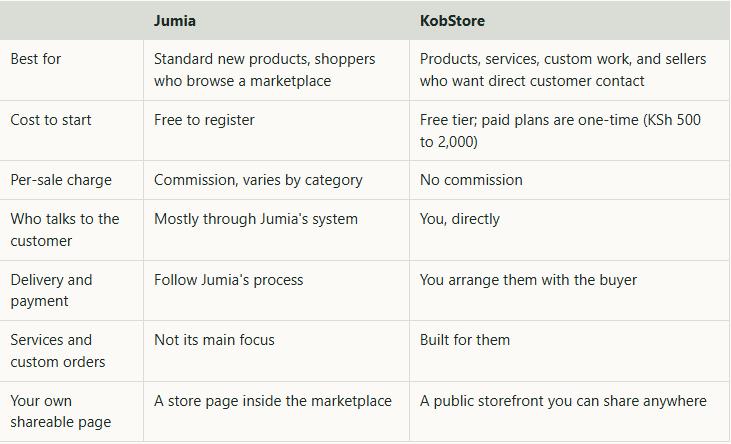
Jumia is a shopping marketplace; KobStore gives each business a public marketing website for product and service listings, prices, photos and contact details. The choice depends on whether you need a marketplace buying journey or a shareable page that explains your business and brings customers directly to you.
KobStore stands out for service providers, custom work, and businesses that want one public page for a wider range of offers and direct customer enquiries. Jumia is a separate marketplace channel for sellers whose products and operations fit its current Kenya seller terms. Sellers can use both for different jobs.
Details below were checked on 5 October 2026. Fees and rules change, so confirm anything that affects your money on the official Jumia and KobStore pages before you decide.
How selling on Jumia works
Jumia has its own seller onboarding, category, fulfilment, and payout terms. Review the current official Kenya seller resources for the requirements and fees that apply to your products.
Jumia presents products in a shared shopping catalogue. Before listing, use its current Kenya seller information to check the category requirements, order process, charges and payout terms for your account.
When to consider Jumia: Your standard products fit its public catalogue and your business can meet the current seller requirements.
Before listing, compare the charges and seller requirements shown in your current Jumia account with your item costs, expected order volume and handling time.
How selling on KobStore works
KobStore gives your business a public marketing website with product and service listings, photos, prices and direct contact details. Google Search can surface the business's published KobStore listings. Foundation is free for up to 10 listings with one image each; paid plans are one-time payments and add capacity, a Verified badge and KobStore marketing placement. KobStore does not deduct commission as a percentage of a seller's sale.
- Foundation (free): Foundation has room for ten listings, each with a single image, at no cost. Publish your first listing within five days of registration. A listing published during setup remains public for 14 days from registration, then is hidden during a five-day deletion notice period. Upgrade before that deadline to keep the account and restore eligible listings; otherwise the account and listings are deleted. If you publish no listing within the first five days, the account enters a five-day deletion notice period and is deleted if you do not upgrade.
Catalyst (KSh 500, paid once): 60 listings, 3 images each, no expiry, and a Verified badge.
Dominion (KSh 1,000, paid once): 200 listings, 4 images each, no expiry, Verified badge, and employee accounts.
Legacy (KSh 2,000, paid once): 500 listings, 5 images each, no expiry, Verified badge, employee accounts and priority KobStore marketing.
KobStore does not deduct commission as a percentage of a seller's sale. Payment arrangements depend on the listing type; check current pricing for applicable plan and add-on charges. If you also sell at a counter, an optional POS add-on tracks stock, prints receipts and keeps a credit book, with tiers priced by cashier logins and branches rather than by how much stock you hold. Check the pricing page for current prices.
When to consider KobStore: You sell services or custom work, or want one shareable marketing website for several offers. KobStore does not charge a percentage commission on seller sales; paid plans and optional add-ons have separate prices.
What to plan for: sellers agree payment and delivery directly with buyers. Public pages can appear in search results and customers can contact the seller; sharing the link through relevant channels helps customers find the offer.
A side-by-side look
Work out the numbers for one product
Take one product and write down the selling price, what it costs you, packaging, delivery, and every charge the platform makes. Here is an illustration with made-up numbers, so replace them with your own and with Jumia's real category rate:
- Compare actual costs: use the current fee schedule shown in each seller account, then include payment, fulfilment, returns and promotion costs before comparing the margin.
- KobStore cost model: KobStore does not deduct commission as a percentage of a seller's sale. Plan and optional promotion prices are shown separately; compare the actual one-time plan or add-on cost with your own order volume.
- Plan comparison: a Catalyst plan is KSh 500 once. Review the current offer and your volume against the pricing page.
Do not stop at the commission. Add packing, delivery and the cost of returns, and compare what is left. A marketplace that brings many orders can still pay off if your margin is healthy, and a marketing website only pays off if customers actually find it.
Which seller fits which platform?
Consider Jumia when your products fit its catalogue and you can meet its current seller terms. Check the actual charges and order process before deciding.

Consider KobStore for services, custom or made-to-order work, or a business that wants one public page for several offers and direct contact details. KobStore does not charge a percentage commission on seller sales; paid plans and optional add-ons are priced separately.
Use both if you have a few standard products that suit a marketplace and a wider offer that does not. Check each platform's rules, and keep your stock numbers consistent. Our guide on keeping product availability accurate explains how.
Get found on KobStore
A marketing website works when people can reach it. Share your link on WhatsApp and your social profiles, add real photos, and write listings that answer the questions customers ask first. Our guides on WhatsApp orders vs an online marketing website and choosing a Jumia alternative for a small business go further.
Try it with a small test
Pick three to five products, or one service.

Write accurate descriptions, photos, prices and delivery details.
Set a spending limit and an end date, such as four weeks.
Track enquiries, orders, returns, response time and what you earned after costs.
Review each week. Fix the listing if the same question keeps coming up.
Where KobStore is the stronger fit

KobStore is stronger when the business sells services or made-to-order work, needs a public page with more than one offer, or wants customers to contact the provider before agreeing scope, availability and price. Its public marketing website supports product and service listings, direct contact and Google Search visibility. Foundation is free for up to 10 listings with one image each; paid plans are one-time and include KobStore marketing placement. KobStore does not deduct commission as a percentage of a seller's sale.
Jumia’s seller terms can vary by category and account. Compare the live Kenya seller offer with KobStore’s published plan and add-on prices; KobStore pages are presentation and enquiry tools, so the seller arranges payment and fulfilment.
Frequently asked questions
Is KobStore a replacement for Jumia? They serve different purposes. Jumia presents products in a shared shopping catalogue; KobStore gives a business a shareable marketing website for its wider offer and customer contact. A seller can compare both for its own needs.
How does KobStore's sales fee compare with Jumia? KobStore does not deduct a percentage from seller sales. Paid plans and any optional promotion have separate prices.
Can I sell services on KobStore?
Yes. KobStore supports listings for services as well as physical products. See advertise services online in Kenya.
Do I have to pay to start?
No. The Foundation tier is free. Paid plans are one-time upgrades.
Can customers contact you through KobStore? Your public page shows the offer and contact details. You handle the conversation and agree payment and delivery directly with the customer.
Ready to see how it looks for your business? Create a free KobStore marketing website and compare it with your Jumia numbers.