


Marketplaces and classified sites bring searchable offers together; Facebook and WhatsApp support discovery and conversation. A KobStore marketing website gives a business one public page for its product and service listings, prices, photos, business details and contact information. These channels can work together.
Use a marketplace or classified site when its customer discovery fits your offer, social channels for conversation, and a KobStore marketing website as a shareable destination for the complete business offer. KobStore pages support products and services, appear on Google Search, and can include paid KobStore marketing placement.
Details below were checked on 5 October 2026. Fees and features change, so confirm them with each platform before you commit.
How Kenyans actually shop online
The Communications Authority of Kenya's customer satisfaction survey, covering July 2024 to June 2025, found that mobile apps accounted for 44.8% of online order placements and receipts, and WhatsApp for 20.2%. Traditional websites accounted for 12%. The regulator described social media as driving discovery, and websites as a complementary but secondary channel. Separate reporting says mobile money underpins nearly two-thirds of e-commerce payments, and more than half of shoppers report meeting inaccurate product descriptions at least occasionally.
What this means for you: customers buy through chats and apps, and they care whether your information is accurate. A page that is easy to open from a WhatsApp message, and that shows correct prices and stock, fits how people already shop.

Start with the problem, not the platform
Write down your bottleneck first:
New people don't find you.
Customers can't understand your offer.
Enquiries are hard to manage.
Repeat buyers can't find your current catalogue.
"More online presence" is too vague to guide your time or money.
Marketplace: shared discovery, platform rules
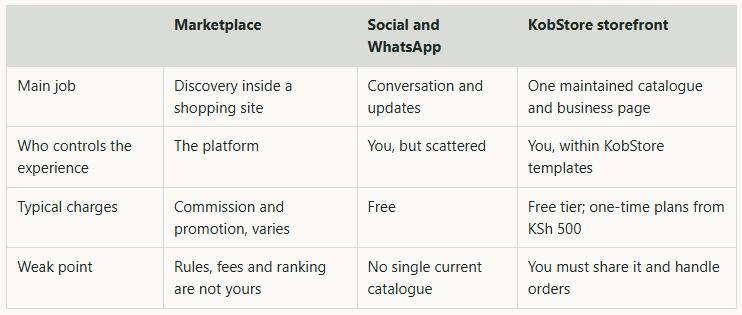
Marketplaces and classifieds have different rules for ranking, contact, fees and order handling. Jiji’s official FAQ confirms paid Premium Services; PigiaMe documents Standard, Silver and Gold boosts. For Jumia and Kilimall, check the current Kenya seller terms for category fees, delivery and payouts rather than relying on a general percentage estimate.
Keep accurate copies of your product details and photos, update availability, and use each service according to its current terms. A KobStore marketing website can complement marketplace listings by giving customers one place to review your other offers and contact the business.
Social media and WhatsApp: conversation-led selling

Social pages and WhatsApp work well when customers want updates, ask questions, or request a custom option. They are weak as a catalogue. Buyers hunt through old posts for a price, ask whether a colour is in stock, and give the same delivery details again and again. Posts sink in the feed, chats are private, and different staff give different answers.
Use them as routes into a clear, current offer. Pin one link to a page that shows what you sell, where you work, and how to order.
A KobStore marketing website: one maintained destination
A KobStore marketing website brings business details, products and services, prices, photos and contact options together. Foundation is free for up to 10 listings with one image each; paid plans are one-time payments that add listing capacity, a Verified badge and KobStore marketing placement. KobStore does not calculate its plan as a percentage of seller sales. The business handles payment, fulfilment and service arrangements directly.
- Foundation (free): The free Foundation tier allows 10 offers, each with one image. Publish your first listing within five days of registration. A listing published during setup remains public for 14 days from registration, then is hidden during a five-day deletion notice period. Upgrade before that deadline to keep the account and restore eligible listings; otherwise the account and listings are deleted. If you publish no listing within the first five days, the account enters a five-day deletion notice period and is deleted if you do not upgrade.
One-time upgrades. Catalyst is KSh 500 (60 listings, no expiry, Verified badge). Dominion is KSh 1,000 and Legacy is KSh 2,000, with more listings and extra marketing.
Counter sales. An optional POS add-on tracks stock, prints receipts and keeps a credit book if you also sell in person.

Know the limits. A KobStore page isn't a custom website or a marketplace. It doesn't bring visitors on its own, deliver your goods, or take payment for you. You are responsible for accurate descriptions, replies, availability, payment and delivery. Check the pricing page for current terms.
Side by side
Two examples
A homeware shop in Nairobi sells from its counter and takes orders on WhatsApp. It can list a few standard items on a marketplace to reach shoppers searching for one product, while its KobStore page carries the full catalogue, opening hours and delivery area. The owner decides which record controls stock. If the last kettle sells at the counter, update that record first, then mark it unavailable everywhere else.
A tailor uses the marketing website to explain fitting locations, turnaround times, alteration types, and what details to send for a quote. An Instagram post can show a work example with permission and link to that page. Keep prices and availability current.

Give each channel one job, such as discovery, product information, enquiry or fulfilment. Drop any channel that needs updating but has no distinct purpose.
Compare effort and cost, not the entry price
For each channel, record fees, listing or transaction charges, payment costs, advertising, delivery costs, and the time you spend keeping things current. Add the hidden costs: re-entering stock, answering the same questions, settling platform disputes, and moving information if you change provider.
Then ask the operating questions. Who owns the customer conversation? Can you export your catalogue? What customer details are visible, and what can you do with them? Who arranges delivery? How are cancellations and returns handled? Is a paid boost needed to be seen? Save the answers with the date you checked.
For a simple test, work out your cost per qualified enquiry: channel cost divided by enquiries that match your product and area. If you have none yet, compare real contact actions, not likes.

Keep one source of truth
Choose where price and stock are recorded, and update every channel from that record. A short weekly checklist works: price, quantity, delivery terms, opening hours, phone number. Name one person responsible, even if it's you. When an item sells out or holiday hours start, use the same checklist to remove stale information everywhere.
Don't open an account just because it's free. A half-finished profile with old stock or an unanswered phone number hurts trust. Start with one or two channels, and add another only when it has a clear purpose and you have time to maintain it.
Run a four-week channel test
Pick one offer and one customer group.
Record your starting numbers: qualified enquiries, time spent answering repeated questions, catalogue errors and orders.
Use the same prices, photos and reply standard everywhere, and ask each customer "How did you find us?"
Review weekly. Count enquiries that fit your area and budget, not every message.
Note where people stop: did they visit but not contact, ask for missing information, or vanish after learning the delivery terms?
After four weeks, keep what brings suitable enquiries at an effort you can sustain, and pause what doesn't.
Keep customer expectations consistent
No channel guarantees sales. State whether a price is fixed or a starting price, whether delivery is included, how long a quote is valid, and what happens if an item is out of stock. For services, explain scope and what you need before quoting. Only promise what you can deliver.
What KobStore adds to a marketplace strategy
KobStore gives the business a public marketing website that brings products, services, prices, photos, business details and direct contact together. Use the same shareable page across WhatsApp, social media, referrals and paid campaigns. Published listings appear on Google Search, while paid plans add KobStore marketing placement. Foundation is free for up to 10 listings with one image each; paid plans are one-time, and KobStore does not calculate its plan as a percentage of seller sales. The business handles payment, order fulfilment and service bookings directly.
Official features checked 17 October 2026: Jiji, PigiaMe, Sell.ke and KobStore pricing.
Frequently asked questions
Marketplace or marketing website: which is better? Compare the features you need. A marketplace presents offers in a shared catalogue; KobStore provides a public business marketing website and listings in KobStore Browse. KobStore does not charge a percentage commission on seller sales; paid plans and add-ons have separate prices.
Is a KobStore page a website? Yes. KobStore hosts a public business marketing website that customers can open through a link. It works alongside WhatsApp and social media.
Are KobStore plan costs based on each sale? No. KobStore does not apply a percentage commission to seller sales. Paid plans are one-time, and optional add-ons are priced separately.
What can a customer do on a KobStore marketing website? A visitor can review the business's published offers and details, then use the contact information to ask a question or discuss an order.
Can I use KobStore with a marketplace?
Yes, if you follow each platform's rules and keep prices and stock consistent.
Want one link that shows your whole offer? Create a free KobStore marketing website and share it in your next WhatsApp message.




