

Selling a service online is not like selling a product. A customer doesn't just pick an item and pay. They describe a problem, share a location, agree what is included, choose a time, and often get a quote first. The platform you choose should support those steps, and you need to know which ones it handles and which ones you must do yourself.
Choose by how customers need to understand and arrange the service. Booking apps may handle parts of the booking flow; directories and classifieds help people browse providers; social channels support conversations. KobStore gives a service business a public marketing website for its service details, coverage area, price basis, photos and contact information. The provider handles enquiries, booking, payment and delivery of the work.
Feature checks for this comparison were made on 17 October 2026 using the providers’ public information. Confirm current terms for the specific service and location before choosing a paid platform.
Describe your service before you pick a platform
Write down the answers to these first:
What result does the customer get?

What is included, and what isn't?
Do you travel, work remotely, or receive clients at your premises?
Is the price fixed, a starting price, or set after an inspection?
How many jobs can you realistically take each week?
Those answers decide which platform will work. A mobile car-wash needs the customer's neighbourhood, vehicle and water access. A tutor needs subject, level and times. A generic product form asks for none of that.
The main platform types in Kenya
Freelance marketplaces
Platforms such as Kuhustle, Onesha and Fixlancer connect freelancers, mainly in digital work like design, writing and web development, with clients. They suit remote services that can be delivered online.
Check: fees, how payment and disputes work, and whether the platform decides which clients you see. They are less useful for local services like plumbing or cleaning.
Service-booking and "fundi" apps
Compare the service apps you are considering by their provider requirements, enquiry or booking process, payment options and current charges.

Questions to ask about a booking app: Does it support your service and location? How do customers request or book work, and what charges apply?
Classifieds like Jiji
Classifieds let you post a service and talk to people browsing categories. Competition is heavy and listings are short, and Jiji sells paid placements for more visibility. Treat it as one source of enquiries, not a booking system.
Directories and Google Business Profile
These help people find you by category and area. A Google Business Profile is free, and shows your hours, phone number, photos and reviews. They are strong for "near me" searches but give little room to explain packages or pricing.
Social media and WhatsApp

Good for showing work, answering questions and building trust. Weak as a catalogue, because customers can't tell which post is current. Pin a link to your full offer, set reply hours, and keep every quote in one record, not scattered through personal chats.
A KobStore marketing website
- Foundation (free): A service business can start with 10 Foundation listings and one image each at no cost. Publish your first listing within five days of registration. A listing published during setup remains public for 14 days from registration, then is hidden during a five-day deletion notice period. Upgrade before that deadline to keep the account and restore eligible listings; otherwise the account and listings are deleted. If you publish no listing within the first five days, the account enters a five-day deletion notice period and is deleted if you do not upgrade.
One-time upgrades. Catalyst is KSh 500 (60 listings, no expiry, Verified badge). Dominion is KSh 1,000 and Legacy is KSh 2,000.
For a service business, a public page can answer the first questions before a client gets in touch: what you do, where you work, how you price the job, and how to reach you.
A custom website

A website offers the most control, with separate pages, a portfolio, FAQs and a booking form, but you handle the domain, hosting, forms, backups and updates, and it won't bring visitors on its own. See business directory vs website.
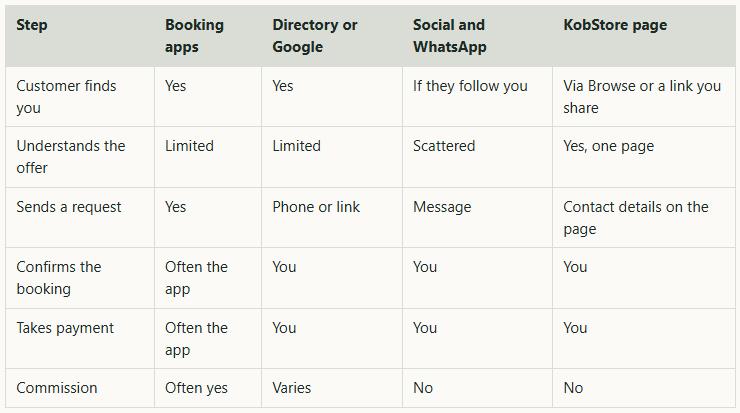
Which platform handles which step?
Plan for your capacity
More enquiries are only good if you can handle them. A full calendar and slow replies damage your reputation faster than a quiet week. Before you promote:
Decide how many jobs you can take each week.
State your working hours and typical reply time on your page.
Pause or close the offer when you are fully booked.
Don't call a request a booking until you've confirmed it.
Put the details a customer must send into your listing, so you spend less time chasing basics.
Compare real costs
Don't judge a platform by views. Add up subscription, commission, advertising, payment fees and your own time, then divide by the number of qualified enquiries. A "qualified" enquiry matches your area, price and schedule. One good project may be worth more than several short consultations, so define it for your own margins.
Run a four-week test
Pick one or two services.
Publish clear pages with real photos, scope, area and price basis.
Set a small budget and an end date.
Record each enquiry: source, fit, reply time, quote, acceptance, completion and profit.
Note why good prospects didn't proceed: timing, travel, budget, unclear proof or a slow reply.
Keep what works and stop what doesn't.
Protect customer information
Collect only what you need to quote. Don't publish client names, addresses or project files without permission. Keep public forms short and move sensitive details to a secure channel. Follow Kenya's Data Protection Act, 2019, and check odpc.go.ke or ask a lawyer whether you need to register as a data controller.
Which should you choose?
- Need customers to book appointments? Compare apps that support your service and location, then check their booking process and charges.
Sell remote digital work: try a freelance marketplace.
Need local discovery: set up Google Business Profile and a directory listing.
Most service businesses do best with two or three, each with a clear job and the same details everywhere.
Why a service provider may choose KobStore
KobStore gives a service business a public marketing website where it can explain the work, service area, price basis, photos and contact details before a customer enquires. Foundation is free for up to 10 listings with one image each; paid plans are one-time payments and include KobStore marketing placement. The provider stays in direct contact with the customer and arranges appointments, payment and delivery of the service. Check KobStore pricing before choosing any paid option.
For classified discovery, compare Jiji’s Premium Services and PigiaMe’s service categories with the audience and enquiry flow your business needs.
Frequently asked questions
What is the best platform for a service business in Kenya? Choose based on your workflow. Compare booking apps if you need appointment scheduling, freelance marketplaces for remote work, and a KobStore marketing website if you want a public page with service details and direct contact.
Does KobStore handle bookings or payments?
No. You confirm the booking and agree payment directly with the customer.
Does KobStore take a share of service fees? No percentage commission is charged on seller sales. One-time plan and optional promotion prices are separate; the provider and client arrange appointments and payment directly.
Can I use more than one platform?
Yes, if you keep your name, prices and service area identical and follow each platform's rules.
How can a client reach a service provider? The page gives the provider room to explain the work, service area and pricing basis, then lets clients make a direct enquiry. The provider agrees scope and timing with each client.
Ready to show your service properly? Create a free KobStore marketing website and publish your first service today.